
PXRDnet: A diffusion model approach to powder diffraction

Introduction
In many areas of materials science, one of the most fundamental—and sometimes elusive—tasks is determining the atomic structure of a material. Historically, researchers relied on single crystals, which yield pristine diffraction patterns and high-quality structural solutions. However, plenty of promising new materials, especially at the nanometer scale, cannot be grown or isolated as single crystals. The resulting powder diffraction data are significantly “information-starved”—the Bragg peaks get broadened due to finite-size effects, and peaks often overlap. Solving a structure in this scenario is exceptionally challenging.
In a new Nature Materials paper, Gabe Guo and colleagues propose a generative machine-learning approach, PXRDnet, that can reconstruct a crystal structure directly from these fuzzy powder patterns. What’s striking is that they employ diffusion-based generative modeling, trained on a large library of known structures, to navigate the complex, multi-dimensional space of possible atomic arrangements. PXRDnet is designed to handle not just minor peak broadening but even the severe line broadening typical of 10 Å crystallites. This marks a substantial leap from earlier AI-based methods, which largely focused on well-crystallized (non-nanoscale) samples.
Why nanostructure analysis is tough
Any researcher who has attempted to solve nanocrystal structures knows the key issue: those beautiful, sharp diffraction peaks you see in large single crystals get smeared out as the crystal becomes smaller. The classical approximation is that each reflection is convolved with a sinc^2 function, related to the finite size of the crystallite. This broadening significantly reduces resolution and amplifies overlapping peaks. Conventional powder refinement schemes, like Rietveld analysis, struggle in these cases because so many degrees of freedom become ambiguous.
On top of that, once you have “messy” data, it is often unclear whether the proposed solution is correct. Two very different structures might produce diffraction patterns that, to the naked eye, look nearly the same when peaks are excessively overlapped. This situation is exactly where data-driven, generative methods can shine, by using prior knowledge from thousands of known structures to constrain the solution space—even if the raw diffraction pattern is incomplete or heavily distorted.
PXRDnet: What’s new
PXRDnet applies a diffusion-based variational autoencoder (VAE) originally built on the CDVAE framework. Rather than simply generating new hypothetical materials, the model conditions its predictions on two crucial pieces of information. First, it incorporates a measured powder diffraction pattern, even if this pattern is broadened due to nanoscale crystal sizes. Second, it uses the chemical formula, specifically the ratio and total count of atoms within the unit cell.
By combining these constraints, PXRDnet learns to “reverse-engineer” the underlying structure, proposing multiple candidate solutions. Each candidate can then be refined via standard local search methods (like Rietveld refinement) to yield a final best fit.
Key points that make PXRDnet stand out:
Broad crystal systems: It was tested across all seven crystal systems (cubic, hexagonal, trigonal, tetragonal, orthorhombic, monoclinic, and triclinic).
Small crystallites: It handles extreme broadening, down to 10 Å crystallite sizes, which is nearly molecule-like.
Generative “candidates”: Instead of providing a single guess, PXRDnet stochastically samples multiple solutions, increasing the chance of capturing the true structure (or something close enough for local refinement to succeed).
Experimental relevance: Although trained primarily on synthetic data from the Materials Project, the authors demonstrate feasibility on a small set of real experimental PXRD patterns.
Key insights
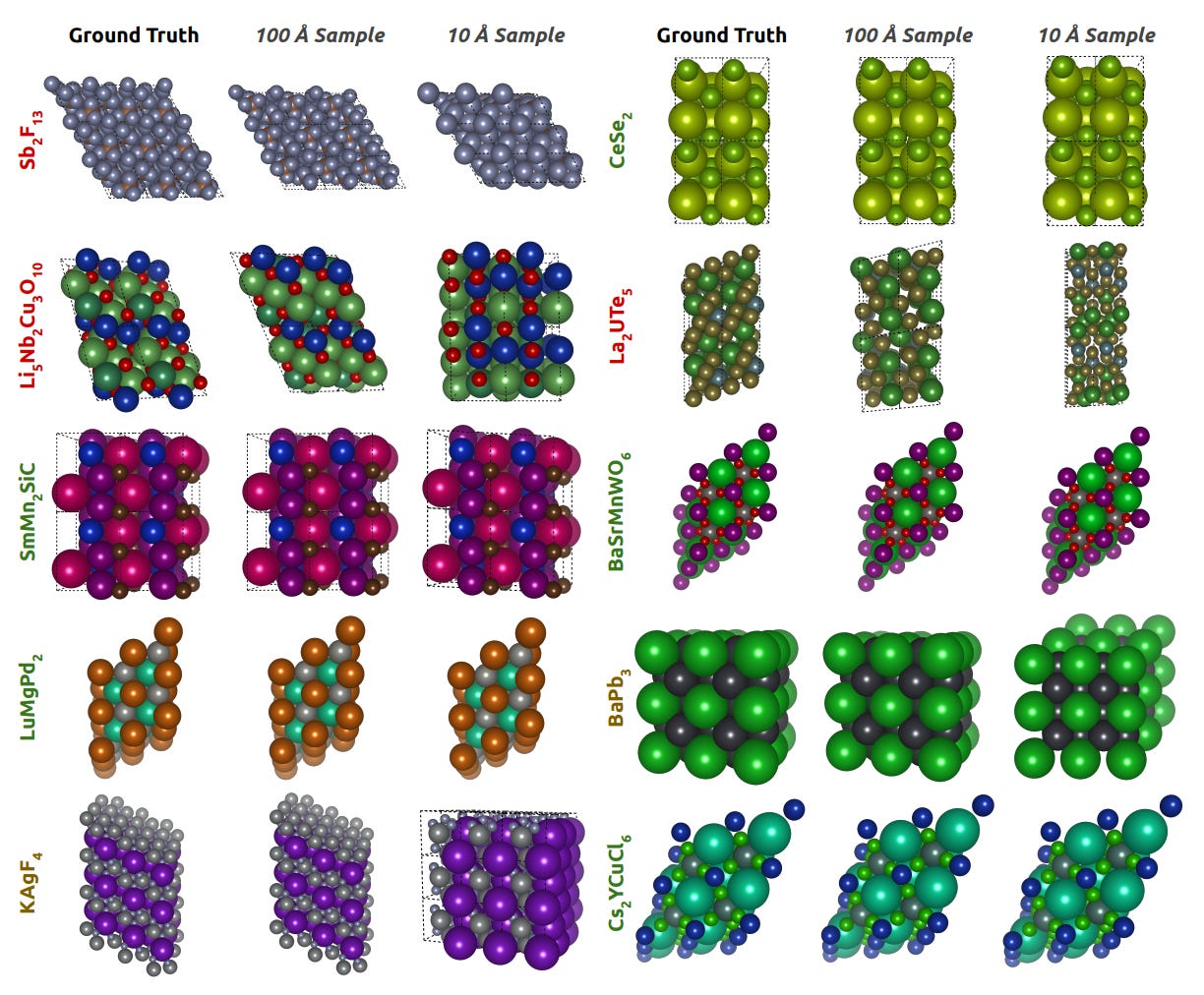
The team built a large training set of over 45,000 crystal structures, each with a simulated powder diffraction pattern artificially broadened for 10 Å and 100 Å crystals. Their generative model, PXRDnet, used these examples to learn how diffraction signals encode partial structural information. Once trained, the model was tested on materials not seen during training:
Success rates: PXRDnet produced structurally correct or nearly correct solutions for a diverse set of test crystals. In many cases, simply picking the “best match” among the model’s top few candidates, then running a short Rietveld refinement, brought the R-factor (a measure of fit quality) below 10%.
Performance by crystal symmetry: As one might suspect, cubic structures proved easier to solve than those with lower symmetries (like triclinic). Broader peak overlap in triclinic or tetragonal phases meant a more challenging puzzle.
Real experimental data: The model was tested on some actual powder diffraction patterns retrieved from IUCr’s database. Despite potential differences (like background scattering, container effects, etc.), PXRDnet still offered plausible solutions, highlighting its potential for real-world workflows.
Refinement still matters: The raw solutions from PXRDnet might show only moderate agreement with the measured pattern, but a short refinement step (the authors used TOPAS software) often fixed small coordinate or lattice-parameter errors, substantially reducing the R-factor.
Final thoughts
By weaving together diffraction physics, AI-based priors, and local refinement, Guo and colleagues provide a proof of concept for automated structure solution in the high-noise regime of nanomaterials. PXRDnet doesn’t guarantee perfect solutions every time, especially for highly complex or low-symmetry structures, but it’s a major step forward in an area historically fraught with guesswork and specialized expertise.
Much like the push in biology to solve ever-larger protein structures via data-driven models, this work hints that machine learning can tackle the “inverse problem” of structural determination, even when classical methods break down. If you’ve struggled with severely broadened powder patterns, or if your system refuses to crystallize beyond a few nanometers, PXRDnet might be a glimpse of the near future—where generative models fill the gap left by incomplete experimental data.